Braille alphabet chart
Letters A to Z
How the braille alphabet is built
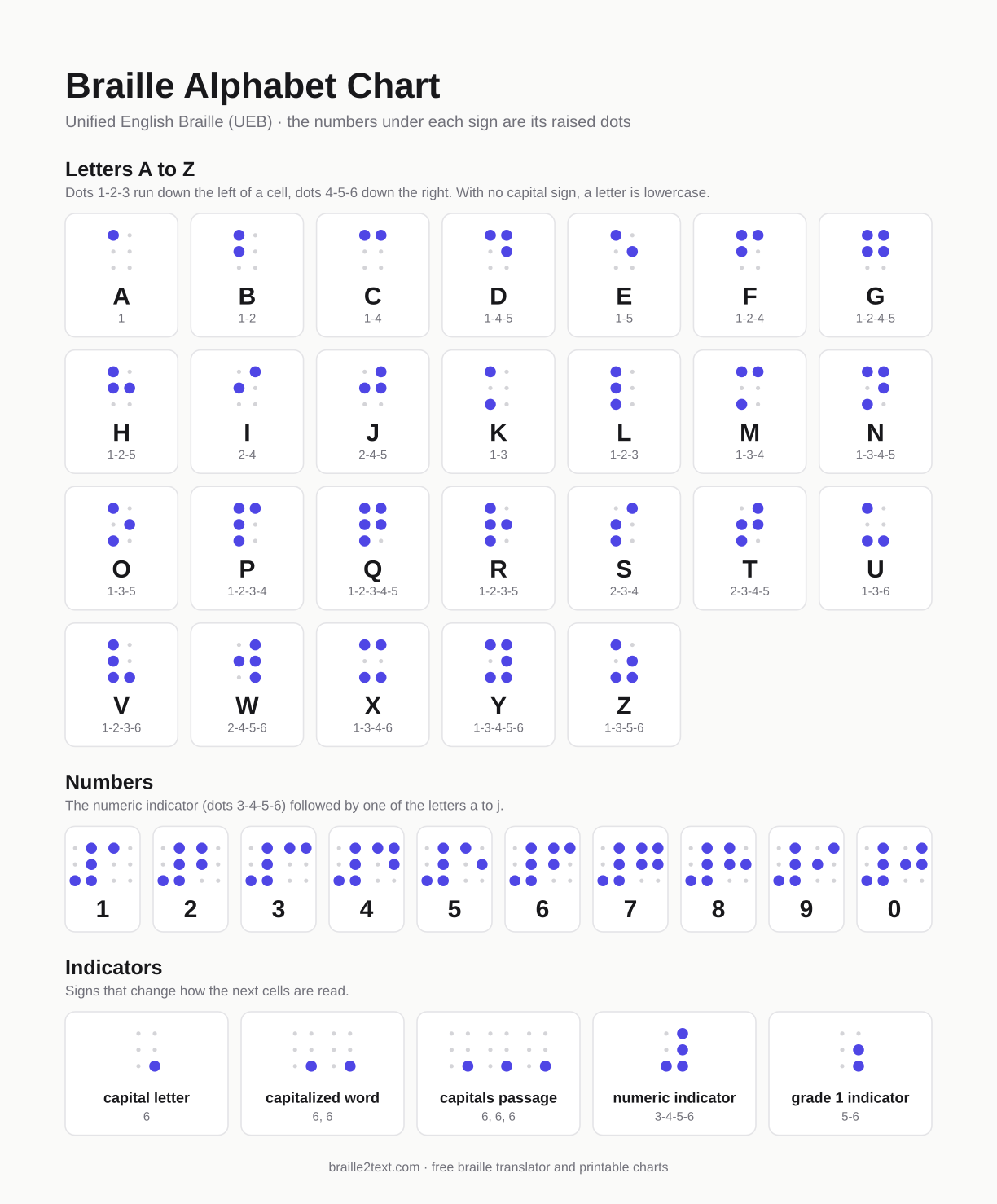
A braille cell has six dot positions: dots 1, 2 and 3 run down the left side, dots 4, 5 and 6 down the right. The 26 letters follow a pattern that makes them easier to learn in groups:
- a to j use only the top four dots of the cell — 1, 2, 4 and 5.
- k to t repeat a to j with dot 3 added: k is a plus dot 3, l is b plus dot 3, and so on.
- u, v, x, y and z repeat a to e with dots 3 and 6 added.
- w breaks the pattern: it is j with dot 6 added, because the French alphabet Louis Braille worked from had no w.
A letter written without a capital sign is lowercase. The first ten letters also stand for the digits 1 to 9 and 0 when the numeric indicator comes before them.
Printable braille alphabet chart
A one-page chart of the letters, numbers and indicators, with a second page of punctuation and symbols. It prints on US Letter paper; on A4, choose “fit to page”. A printed chart shows braille for sighted readers — it is not raised, so it cannot be read by touch.
Numbers
Each digit is the numeric indicator (dots 3-4-5-6) followed by one of the letters a to j. Numbers 1 to 100, decimals, times and dates are on the braille numbers page.
Punctuation
The question mark and the opening quotation mark are the same cell, dots 2-3-6: a question mark follows a word, an opening quotation mark comes before one.
Symbols
Indicators
- Capital letter (dot 6) makes the next letter a capital; two capital signs capitalize a whole word.
- Capitals passage (three capital signs) capitalizes three or more words in a row, until the capitals terminator, dots 6, 3.
- Numeric indicator (dots 3-4-5-6) turns the letters a to j that follow into digits.
- Grade 1 indicator (dots 5-6) tells the reader that the next cell means just a letter — for example a letter straight after a number, or a single letter in contracted braille that would otherwise stand for a whole word.
Frequently asked questions
Common questions about how the braille alphabet works.